Guides · Mount Dora, Florida
The History of Mount Dora in 7 Landmarks
Mount Dora is a town that has made a career out of being looked at, which makes it fitting that its history is best told through the things you can still walk up to and touch.
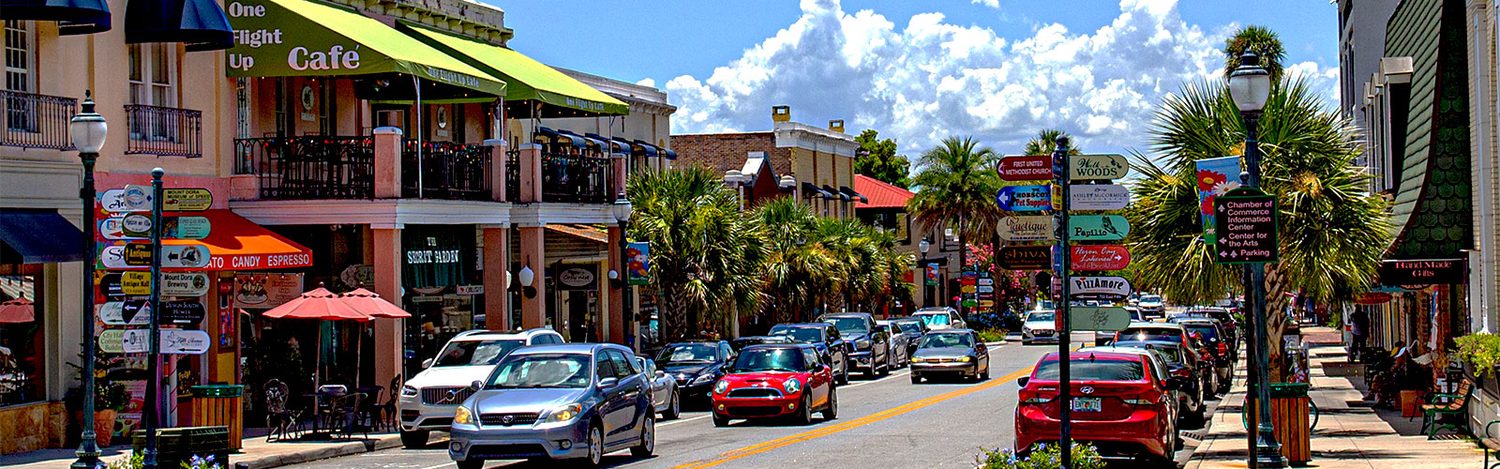
We are not going to give you a timeline. We are not going to pretend the town was founded by anyone in particular, because the record does not oblige us with a name. What we have instead are seven physical anchors, each one a small argument for why this particular patch of Lake County keeps drawing people in and, more importantly, keeping them here.
The Water
Start where the town starts: the lake. Mount Dora sits on a plateau, which is the first thing that feels like a lie. Florida is flat, except when it is not, and this is one of the not-flat parts. The lake gives the town its reason for existing, its postcard views, and its seasonal influx of people who do not live here year-round.
The census tells a quiet story. Of the 8,121 housing units in town, 500 are held for seasonal or recreational use. That is not a resort town's number; that is a town where people keep a place because they intend to come back. The median age here is 48.8 years, which means the waterfront is not primarily a party scene. It is a place to watch the light change.
The Downtown Grid
The streets that fan out from the waterfront are the second landmark, though they are technically dozens of landmarks arranged in a walkable pattern. Mount Dora's downtown is not a strip mall pretending to be a village. It is an actual grid of storefronts and crosswalks, and twice a year it becomes the stage for events that pull people from well beyond Lake County.
The Mount Dora Arts Festival arrives the first full weekend of February, bringing hundreds of national artists who set up painting, sculpture and photography through the downtown streets. The Mount Dora Craft Fair does something similar each October, with more than 350 exhibitors filling the same blocks. Sunshine Artist magazine named that craft fair the number one all-time favourite classic and contemporary craft festival in America in its 50th anniversary edition.
You do not get that kind of designation by accident. You get it by having a downtown that is actually worth the trouble of setting up a tent.
The Train Station
You cannot name the station because we do not have its name in the record, but you can name what it represents: arrival. Mount Dora became a town because people figured out how to get here, and the rail line was the most reliable way to do that for a long stretch of its history. The station building still stands near the downtown core, a low-slung structure that does not try to impress you.
It does not need to. It is the reason the town has a downtown at all. Without a way to move goods and people in and out, this would just be another lakeside settlement that faded when the highway moved elsewhere. Instead, the station anchored a commercial district that has outlived the trains that once justified it.
The Old Courthouse Grounds
We cannot tell you what year the courthouse was built, because we do not have that fact. But we can tell you the ground it sits on has been the civic center of the town for as long as anyone alive can remember, which is a different kind of authority. The courthouse square is where the town conducts its public business, and it is also where the town goes to argue about whether the public business is being conducted correctly.
That is the function of a courthouse. It is not a monument to justice; it is a monument to the idea that disputes can be settled in a building rather than in the street. Mount Dora has kept that building in the middle of things, which tells you something about how this town handles disagreement. It prefers to do it indoors.
The Residential Streets
The third landmark is not a single house but the pattern of houses. Mount Dora's older residential neighborhoods sit on streets that were laid out when walking to the downtown was the normal way to get groceries, not a leisure activity. The homes are a mix of styles, and we are not going to pretend to be architectural historians. What matters is the density.
This is a town where 37.5 percent of residents hold a bachelor's degree or higher, which is a number that usually tracks with places that have done a good job preserving what they built rather than tearing it down for something newer and worse. The median home value is $316,100, and the median gross rent is $1,500. Those figures are not cheap, but they are not insane either. They suggest a town that has managed to stay desirable without becoming a gated enclave.
The Vacant Lots and Empty Rooms
Here is the landmark nobody photographs: the 992 vacant housing units. That is 12.2 percent of the town's housing stock sitting empty, according to the census. Some of that is seasonal. Some of it is the normal churn of a small market. But some of it is the town holding its breath.
Vacancy is not failure. In a place this old, vacancy is often a pause between occupants, a chance for a building to reset. The town's unemployment rate is 5.1 percent, and its median household income is $69,931. Those are solid numbers for a Florida town of 16,812 people. The empty rooms are not a sign of decline; they are a sign of a market that has not yet decided what it wants to become next.
The Festival Crowds
The seventh landmark is not built of wood or stone. It is the crowd itself, the annual reappearance of tens of thousands of people who come to look at art, buy crafts, and fill the streets with the specific energy of a town that knows how to host. The Arts Festival and the Craft Fair are the two biggest expressions of this, but they are not the only ones. The town simply has a habit of turning its public spaces into temporary stages.
That is the history of Mount Dora in its truest form. Not a series of dates and names, but a repeated pattern: people arrive, they look around, they decide to stay for the weekend or for the rest of their lives. The 500 seasonal homes suggest the former. The 48.8 median age suggests the latter.
Mount Dora is not a town that happened once. It is a town that keeps happening, every February, every October, every time someone walks down to the lake and decides that this particular plateau is where they want to be. The landmarks are just the props. The real history is the people who keep showing up.
Every business named above is one we hold a listing for, and every date traces to a source on our sources page. We do not describe menus, interiors or service we have not verified. Details change — confirm before you travel.